> ## Documentation Index
> Fetch the complete documentation index at: https://docs.morphllm.com/llms.txt
> Use this file to discover all available pages before exploring further.
# Prompt Caching
> Automatic prefix caching on every open source model. Cached input at $0.22/1M on GLM-5.2, with per-request TTL control.
Prefix caching is on for every open source model. No configuration, no cache-write surcharge. When a request shares a prefix with earlier traffic (system prompt, tool definitions, conversation history), those tokens skip prefill and bill at the cached rate.
| Model | ID | Input per 1M | Cached input per 1M | Output per 1M |
| ---------------------------------- | ------------------ | ------------ | ------------------- | ------------- |
| **GLM-5.2 744B** | `morph-glm52-744b` | \$1.10 | **\$0.22** | \$4.10 |
| **Kimi K3** coming soon | — | — | — | — |
Cached input on GLM-5.2 is 80% off. Other open source models cache automatically too; their cached tokens currently bill at the regular input rate.
## Reading cache hits
Every response reports how much of the prompt was served from cache:
```json theme={null}
{
"usage": {
"prompt_tokens": 18211,
"completion_tokens": 512,
"total_tokens": 18723,
"prompt_tokens_details": { "cached_tokens": 17408 }
}
}
```
`cached_tokens` billed at the cached rate, the remainder of `prompt_tokens` at the input rate.
## Getting hits
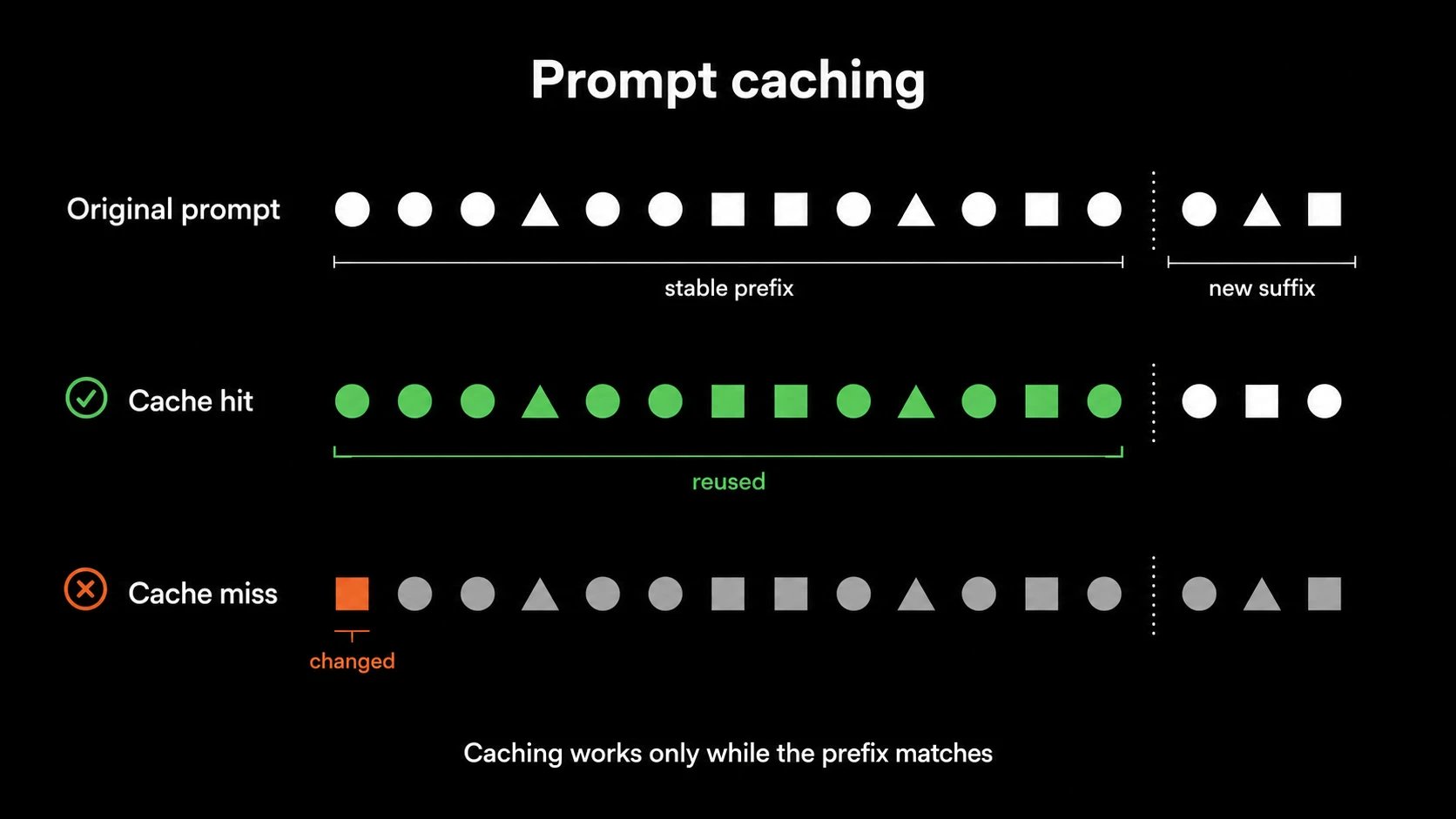 Matching is exact-prefix and block-aligned. To maximize hit rate:
* Put stable content first: system prompt, then tool definitions, then history. Variable content (the user's latest message, retrieved context) goes last.
* Keep the prefix byte-identical between turns. A timestamp or request ID in the system prompt kills every hit after it.
* Short prompts rarely hit. Caching operates on \~1k-token blocks, so a 300-token prompt has nothing to reuse.
Multi-turn agent loops get this for free: each turn re-sends the previous turns verbatim, so everything but the newest turn is a cache hit.
## Cache TTL
By default cached prefixes persist under LRU eviction, with no fixed expiry. To control retention per request, pass `cache_ttl`:
| Value | Retention |
| ------- | ---------- |
| `"5m"` | 5 minutes |
| `"30m"` | 30 minutes |
| `"1h"` | 1 hour |
| `"6h"` | 6 hours |
| `"24h"` | 24 hours |
Expiry is sliding, Anthropic-style: every cache hit refreshes the clock. Past the TTL the prefix stops hitting entirely (full recompute), and re-sending it caches it fresh. A prefix shared by multiple requests keeps the longest surviving TTL.
`cache_ttl` is rolling out now, GLM-5.2 first and Kimi K3 at launch. Requests that include it are accepted today; the field takes effect as each model's rollout completes.
```bash theme={null}
curl -X POST "https://api.morphllm.com/v1/chat/completions" \
-H "Authorization: Bearer YOUR_API_KEY" \
-H "Content-Type: application/json" \
-d '{
"model": "morph-glm52-744b",
"messages": [{"role": "user", "content": "..."}],
"cache_ttl": "1h"
}'
```
```python theme={null}
from openai import OpenAI
client = OpenAI(
api_key="YOUR_API_KEY",
base_url="https://api.morphllm.com/v1",
)
# Non-standard fields go via extra_body
response = client.chat.completions.create(
model="morph-glm52-744b",
messages=[{"role": "user", "content": "..."}],
extra_body={"cache_ttl": "1h"},
)
```
```typescript theme={null}
import OpenAI from "openai";
const client = new OpenAI({
apiKey: "YOUR_API_KEY",
baseURL: "https://api.morphllm.com/v1",
});
const response = await client.chat.completions.create({
model: "morph-glm52-744b",
messages: [{ role: "user", content: "..." }],
// @ts-expect-error non-standard field
cache_ttl: "1h",
});
```
Fine print:
* Invalid `cache_ttl` values are rejected with a 400. Only the five tiers above are accepted.
* Expiry granularity is \~30 seconds: treat a TTL as "at least this long, expired within \~30s after."
* Omitting `cache_ttl` keeps the default behavior (LRU, no fixed expiry).
## Pitfalls
Your prefix is changing between requests. Diff two consecutive prompts byte-for-byte; the first divergent token ends the cacheable prefix. Common culprits: timestamps, UUIDs, or shuffled tool order in the system prompt.
Editing an earlier message invalidates everything after it. Expected: caching is prefix-based, so append, don't rewrite.
## See Also
* [Standby Requests](/sdk/components/standby) — stack a 50% tier discount on top: cached standby input is \$0.11/1M
* [Open Source Models](/sdk/components/fast-models) — the models this page prices
* [Compact](/sdk/components/compact) — shrink context before caching it
Matching is exact-prefix and block-aligned. To maximize hit rate:
* Put stable content first: system prompt, then tool definitions, then history. Variable content (the user's latest message, retrieved context) goes last.
* Keep the prefix byte-identical between turns. A timestamp or request ID in the system prompt kills every hit after it.
* Short prompts rarely hit. Caching operates on \~1k-token blocks, so a 300-token prompt has nothing to reuse.
Multi-turn agent loops get this for free: each turn re-sends the previous turns verbatim, so everything but the newest turn is a cache hit.
## Cache TTL
By default cached prefixes persist under LRU eviction, with no fixed expiry. To control retention per request, pass `cache_ttl`:
| Value | Retention |
| ------- | ---------- |
| `"5m"` | 5 minutes |
| `"30m"` | 30 minutes |
| `"1h"` | 1 hour |
| `"6h"` | 6 hours |
| `"24h"` | 24 hours |
Expiry is sliding, Anthropic-style: every cache hit refreshes the clock. Past the TTL the prefix stops hitting entirely (full recompute), and re-sending it caches it fresh. A prefix shared by multiple requests keeps the longest surviving TTL.
`cache_ttl` is rolling out now, GLM-5.2 first and Kimi K3 at launch. Requests that include it are accepted today; the field takes effect as each model's rollout completes.
```bash theme={null}
curl -X POST "https://api.morphllm.com/v1/chat/completions" \
-H "Authorization: Bearer YOUR_API_KEY" \
-H "Content-Type: application/json" \
-d '{
"model": "morph-glm52-744b",
"messages": [{"role": "user", "content": "..."}],
"cache_ttl": "1h"
}'
```
```python theme={null}
from openai import OpenAI
client = OpenAI(
api_key="YOUR_API_KEY",
base_url="https://api.morphllm.com/v1",
)
# Non-standard fields go via extra_body
response = client.chat.completions.create(
model="morph-glm52-744b",
messages=[{"role": "user", "content": "..."}],
extra_body={"cache_ttl": "1h"},
)
```
```typescript theme={null}
import OpenAI from "openai";
const client = new OpenAI({
apiKey: "YOUR_API_KEY",
baseURL: "https://api.morphllm.com/v1",
});
const response = await client.chat.completions.create({
model: "morph-glm52-744b",
messages: [{ role: "user", content: "..." }],
// @ts-expect-error non-standard field
cache_ttl: "1h",
});
```
Fine print:
* Invalid `cache_ttl` values are rejected with a 400. Only the five tiers above are accepted.
* Expiry granularity is \~30 seconds: treat a TTL as "at least this long, expired within \~30s after."
* Omitting `cache_ttl` keeps the default behavior (LRU, no fixed expiry).
## Pitfalls
Your prefix is changing between requests. Diff two consecutive prompts byte-for-byte; the first divergent token ends the cacheable prefix. Common culprits: timestamps, UUIDs, or shuffled tool order in the system prompt.
Editing an earlier message invalidates everything after it. Expected: caching is prefix-based, so append, don't rewrite.
## See Also
* [Standby Requests](/sdk/components/standby) — stack a 50% tier discount on top: cached standby input is \$0.11/1M
* [Open Source Models](/sdk/components/fast-models) — the models this page prices
* [Compact](/sdk/components/compact) — shrink context before caching it