> ## Documentation Index
> Fetch the complete documentation index at: https://docs.morphllm.com/llms.txt
> Use this file to discover all available pages before exploring further.
# Compact
> Drop filler from chat history at 33,000 tok/s. No rewriting, no paraphrasing.
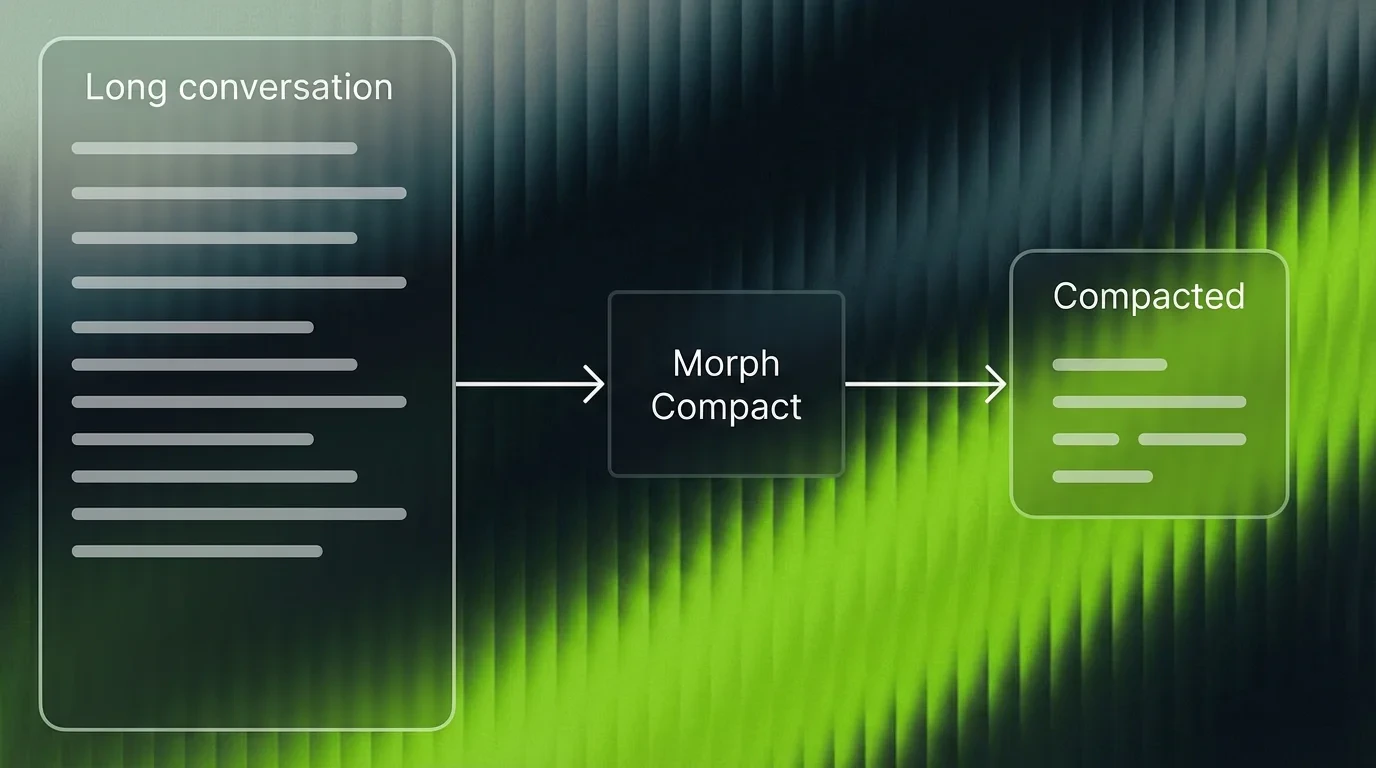
Drop filler from chat history and code context at **33,000 tok/s**. 50-70% reduction, every surviving line byte-for-byte identical to input.
Compaction works by **deleting entire lines** from the input — it never rewrites or paraphrases. This means if more than \~10% of the context you feed in lives on a single line, compaction cannot selectively trim within that line and results will be poor. Split long single-line payloads (e.g., minified code or giant JSON blobs) into multiple lines before compacting.
| | |
| --------------------- | ---------------------------------------- |
| **Model** | `morph-compactor` |
| **Speed** | 33,000 tok/s |
| **Context window** | 1M tokens |
| **Typical reduction** | 50-70% fewer tokens |
| **Output** | Verbatim lines from input (no rewriting) |
## Quick Start
**Logged in?** Your API key auto-fills in the code blocks below. Otherwise, get it from your [dashboard](https://morphllm.com/dashboard/api-keys).
```typescript theme={null}
import { MorphClient } from '@morphllm/morphsdk';
const morph = new MorphClient({ apiKey: "YOUR_API_KEY" });
const result = await morph.compact({
input: chatHistory,
query: "How do I validate JWT tokens?",
});
// Pass compressed history to your LLM
const response = await anthropic.messages.create({
model: "claude-sonnet-4-5-20250929",
messages: [
{ role: "user", content: result.output },
{ role: "user", content: "How do I validate JWT tokens?" },
],
});
```
```bash theme={null}
curl -X POST "https://api.morphllm.com/v1/compact" \
-H "Authorization: Bearer YOUR_API_KEY" \
-H "Content-Type: application/json" \
-d '{
"input": "def hello():\n return 1\n\ndef unused():\n pass\n\ndef world():\n return 2",
"query": "hello function",
"compression_ratio": 0.5,
"preserve_recent": 0
}'
```
```typescript theme={null}
import OpenAI from 'openai';
const client = new OpenAI({
apiKey: "YOUR_API_KEY",
baseURL: "https://api.morphllm.com/v1",
});
const response = await client.chat.completions.create({
model: "morph-compactor",
messages: [{ role: "user", content: chatHistory }],
});
const compressed = response.choices[0].message.content;
```
```python theme={null}
from openai import OpenAI
client = OpenAI(
api_key="YOUR_API_KEY",
base_url="https://api.morphllm.com/v1",
)
response = client.chat.completions.create(
model="morph-compactor",
messages=[{"role": "user", "content": chat_history}],
)
compressed = response.choices[0].message.content
```
```python theme={null}
import requests
response = requests.post(
"https://api.morphllm.com/v1/compact",
headers={"Authorization": "Bearer YOUR_API_KEY"},
json={
"input": source_code,
"query": "authentication",
"compression_ratio": 0.5,
"preserve_recent": 0,
},
)
data = response.json()
print(data["output"])
```
## Query-Conditioned Compression
The `query` parameter tells the model what matters. The model scores every line's relevance to that query, then drops lines below the threshold.
```typescript theme={null}
// Same chat history, different queries, different output
const forAuth = await morph.compact({
input: chatHistory,
query: "JWT token validation",
});
// DB setup and CSS discussion dropped, auth code kept
const forDB = await morph.compact({
input: chatHistory,
query: "database connection pooling",
});
// Auth code dropped, DB setup kept
```
Without `query`, the model auto-detects from the last user message. Explicit queries give tighter compression.
## Line Ranges and Markers
By default, each message includes `compacted_line_ranges` (which lines were removed) and `(filtered N lines)` markers in the text. Both are configurable:
```typescript theme={null}
// Default: markers + ranges
const result = await morph.compact({
input: codeFile,
query: "auth middleware",
compressionRatio: 0.5,
preserveRecent: 0,
});
console.log(result.output);
// def authenticate():
// ...
// (filtered 12 lines)
// def handle_request():
// ...
for (const r of result.messages[0].compacted_line_ranges) {
console.log(`lines ${r.start}-${r.end} removed`);
}
// No markers: empty lines instead of "(filtered N lines)"
await morph.compact({ input: codeFile, includeMarkers: false });
// No line ranges: skip tracking removed ranges
await morph.compact({ input: codeFile, includeLineRanges: false });
// result.messages[0].compacted_line_ranges === []
```
## Preserving Critical Context
Wrap sections you never want compressed in `` / `` tags. Tagged content survives compression verbatim regardless of the compression ratio.
```typescript theme={null}
const input = `
// Database connection setup
const pool = new Pool({ host: 'localhost', port: 5432 });
// CRITICAL: Auth middleware - do not compress
function authenticate(req, res, next) {
const token = req.headers.authorization?.split(' ')[1];
if (!token) return res.status(401).json({ error: 'No token' });
const decoded = jwt.verify(token, process.env.JWT_SECRET);
req.user = decoded;
next();
}
// Logging utilities
function logRequest(req) { console.log(req.method, req.path); }
function logError(err) { console.error(err.stack); }
// ... 200 more lines of helpers
`;
const result = await morph.compact({
input,
query: "authentication",
compressionRatio: 0.3,
});
// The authenticate() function is fully preserved.
// DB setup and logging helpers are compressed.
// The tags themselves are stripped from output.
```
**Rules:**
* Tags must be on their own line (no inline `code() `)
* Tags must open and close within the same message
* Kept content counts against the `compression_ratio` budget. If you keep 40% and request 0.5, the remaining 60% compresses harder to hit the target.
* Unclosed `` preserves everything from the tag to the end of the message
The response includes `kept_line_ranges` showing which lines were force-preserved:
```typescript theme={null}
for (const r of result.messages[0].kept_line_ranges) {
console.log(`lines ${r.start}-${r.end} preserved via keepContext`);
}
```
## API Reference
### `POST /v1/compact`
The primary endpoint. Accepts string input or message arrays.
**Parameters**
| Parameter | Type | Default | Description |
| -------------------------- | --------------- | ----------------- | ----------------------------------------------------------------------------------------- |
| `input` | string or array | - | Text or `{role, content}` array. One of `input`/`messages` required. |
| `messages` | array | - | `{role, content}` messages. Takes priority over `input`. |
| `query` | string | auto-detected | Focus query for relevance-based pruning |
| `compression_ratio` | float | `0.5` | Fraction to keep. `0.3` = aggressive, `0.7` = light |
| `preserve_recent` | int | `2` | Keep last N messages uncompressed |
| `compress_system_messages` | bool | `false` | When `true`, system messages are also compressed. By default they are preserved verbatim. |
| `include_line_ranges` | bool | `true` | Include `compacted_line_ranges` in response |
| `include_markers` | bool | `true` | Include `(filtered N lines)` text markers. When `false`, gaps become empty lines |
| `model` | string | `morph-compactor` | Model ID |
**Response**
```json theme={null}
{
"id": "cmpr-7373faf8af65",
"object": "compact",
"model": "morph-compactor",
"output": "def hello():\n print(\"hello world\")\n(filtered 6 lines)\ndef world():\n return 42",
"messages": [
{
"role": "user",
"content": "def hello():\n print(\"hello world\")\n(filtered 6 lines)\ndef world():\n return 42",
"compacted_line_ranges": [{ "start": 5, "end": 10 }],
"kept_line_ranges": []
}
],
"usage": {
"input_tokens": 101,
"output_tokens": 65,
"compression_ratio": 0.644,
"processing_time_ms": 109
}
}
```
### `POST /v1/chat/completions`
OpenAI Chat Completions format. Drop-in replacement for any OpenAI-compatible client pointed at `https://api.morphllm.com/v1`. Supports streaming via `stream: true`.
| Parameter | Type | Required | Description |
| ------------------- | ------ | -------- | --------------------------------------- |
| `model` | string | Yes | `morph-compactor` |
| `messages` | array | Yes | `{role, content}` message array |
| `compression_ratio` | float | No | Fraction to keep (default 0.5) |
| `query` | string | No | Focus query for relevance-based pruning |
| `stream` | bool | No | Enable SSE streaming |
```json theme={null}
{
"id": "cmpr-def456",
"object": "chat.completion",
"model": "morph-compactor",
"choices": [{
"index": 0,
"message": { "role": "assistant", "content": "compressed text..." },
"finish_reason": "stop"
}],
"usage": { "prompt_tokens": 4200, "completion_tokens": 1800, "total_tokens": 6000 }
}
```
### `POST /v1/responses`
OpenAI Responses API format. Works with OpenAI SDK v5+ (TS) or v1.66+ (Python) pointed at `https://api.morphllm.com/v1`.
| Parameter | Type | Required | Description |
| --------- | --------------- | -------- | --------------------------------------- |
| `model` | string | Yes | `morph-compactor` |
| `input` | string or array | Yes | Text or `{role, content}` array |
| `query` | string | No | Focus query for relevance-based pruning |
```json theme={null}
{
"id": "cmpr-abc123",
"object": "response",
"model": "morph-compactor",
"output": [{
"type": "message",
"role": "assistant",
"content": [{ "type": "output_text", "text": "compressed text..." }]
}],
"usage": { "input_tokens": 4200, "output_tokens": 1800 }
}
```
### Errors
| Status | Meaning |
| ------ | ------------------------------------ |
| `400` | Malformed request or input too large |
| `401` | Invalid API key |
| `503` | Model not loaded |
| `504` | Request timed out |
## SDK Reference
**`CompactInput`**
```typescript theme={null}
{
input?: string | Array<{ role: string, content: string }>,
messages?: Array<{ role: string, content: string }>,
query?: string,
compressionRatio?: number, // 0.05-1.0, default 0.5
preserveRecent?: number, // default 2
includeLineRanges?: boolean, // default true
includeMarkers?: boolean, // default true
model?: string,
}
```
**`CompactResult`**
```typescript theme={null}
{
id: string,
output: string, // all messages joined
messages: Array<{
role: string,
content: string,
compacted_line_ranges: Array<{ start: number, end: number }>,
kept_line_ranges: Array<{ start: number, end: number }>, // force-preserved via
}>,
usage: { input_tokens, output_tokens, compression_ratio, processing_time_ms },
model: string,
}
```
**`CompactConfig`**
```typescript theme={null}
{
morphApiKey?: string, // defaults to MORPH_API_KEY env
morphApiUrl?: string,
timeout?: number, // defaults to 120000 (2 min)
retryConfig?: RetryConfig,
debug?: boolean,
}
```
### Edge / Cloudflare Workers
```typescript theme={null}
import { CompactClient } from '@morphllm/morphsdk/edge';
export default {
async fetch(request: Request, env: Env) {
const compact = new CompactClient({ morphApiKey: env.MORPH_API_KEY });
const { input, query } = await request.json();
const result = await compact.compact({ input, query });
return Response.json({ output: result.output, usage: result.usage });
}
};
```
## Best Practices
Set `preserve_recent` to at least **3**. Recent turns contain the user's active intent and the assistant's latest reasoning. Compacting them risks dropping context the LLM needs right now.
Without it, the model falls back to auto-detection from the last user message. An explicit query gives tighter, more relevant compression because the model knows exactly which lines to score.
The value is in reducing what you **send** to your LLM. Compacting a response after generation saves storage but doesn't cut inference cost.
Default `0.5` is a good starting point. Agent loops past 100 turns: try `0.3`. Shorter conversations where nuance matters: try `0.7`.
```typescript theme={null}
const result = await morph.compact({
input: chatHistory,
query: "rate limiting",
preserveRecent: 3, // last 3 messages pass through untouched
});
```
## FAQ
Summarization rewrites. Compaction deletes. Every sentence that survives compaction is character-for-character identical to your original. No drift, no hallucinated context.
Agent loops past 50 turns. Multi-session chat where you carry history forward. Any pipeline where you pay for tokens that are greetings and filler.
Both work. A conversation array preserves role structure through compaction.
Yes. Point `baseURL` at `https://api.morphllm.com/v1` and call `client.chat.completions.create()` with `model: "morph-compactor"`. The Responses API (`client.responses.create()`) also works.
33,000 tok/s. 100K tokens compresses in under 2 seconds. 180K tokens in about 3 seconds.
## Notes for AI Coding Agents
If you are an AI coding agent integrating Morph Compact into a project, follow these steps:
**1. Understand the existing compaction logic.** Before writing any code, read the project's current context management. This might be in pre-commit hooks, middleware, a context window manager, or a custom prompt builder. Search for keywords like `compact`, `compress`, `truncate`, `summarize`, or `context` in the codebase.
**2. Choose the right integration method.**
* If the project uses **TypeScript/JavaScript**, use the `@morphllm/morphsdk` package — it handles retries, types, and edge runtime support out of the box.
* If the project uses **Python with OpenAI SDK**, point the client at `https://api.morphllm.com/v1` and call `chat.completions.create()` with `model: "morph-compactor"`.
* For **any other language**, call `POST /v1/compact` directly with a JSON body containing `input` (or `messages`) and optionally `query`.
**3. Follow best practices.**
* Always pass `query` — set it to the user's current question or task description for much better compression.
* Set `preserve_recent` to at least 3 to keep the latest turns intact.
* Compact **before** sending to the LLM, not after — the goal is to reduce inference cost.
* Use `compression_ratio: 0.3` for long agent loops (100+ turns), `0.7` for shorter conversations.
* Wrap critical context in `` tags if certain sections must never be removed.
 Drop filler from chat history and code context at **33,000 tok/s**. 50-70% reduction, every surviving line byte-for-byte identical to input.